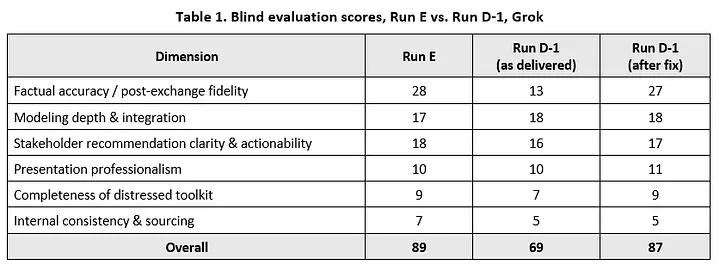
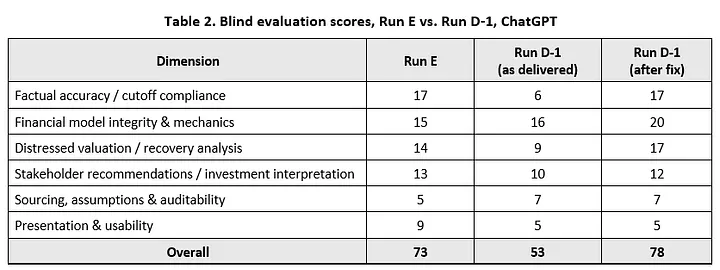
- About 33% higher. Scored blind, the default agent averaged 81 out of 100, against 61 for Foresight's output as delivered.
- Roughly level after a fix. Restoring two figures Foresight had omitted closed the gap without reversing it: Grok still ranked the default agent ahead (89 vs. 87), while ChatGPT ranked Foresight ahead (78 vs. 73).
- 20 minutes, about $6. Foresight's run took about 1.5 hours and roughly $32.
- No reasons on record. The default agent's assumptions came with no explanation, which made its work hard for a reviewer to judge.
Takeaway: For analysis built on relatively simple modeling, handing the whole job to a default agent is now a realistic option. What remains unsolved is whether its process can be relied on: what data it gathers, and why it picks the assumptions it does.
How good is the analysis when an AI workspace's built-in agent receives a short request, gathers its own data from the internet, and builds its own model with no detailed instructions — and at what cost?
The case is the same as Test 1, Test 2, and Test 3: Beyond Meat, Inc. as a distressed-investment opportunity. The comparison is Foresight's open-data run from Test 3 against a run that used none of Foresight's prompts.
Both runs used Claude Opus 4.8 with High Thinking, started with no memory of earlier sessions, and were held to the same information cutoff of December 8, 2025. Only the instructions differed: Foresight's detailed workflow, an 8,000-word prompt set, in one run, and a two-sentence request in the other. Whenever the default agent paused to ask a clarifying question, I told it to make the call itself, so the run stayed fully delegated.
- Instructions: Foresight's full prompt set.
- Data: open internet, no data room.
- ~1.5 hours, 1,278K output tokens (~$32).
- Instructions: the two-sentence request below.
- Data: open internet, no data room.
- ~20 minutes, 228K output tokens (~$6) at Claude Opus 4.8's list rate of $25 per million output tokens.
Objective: Evaluate Beyond Meat as a distressed investment opportunity through financial analysis and modeling, and interpret the analytical outcomes into recommendations for key stakeholders. Save all considerations, data, models, and outputs to the local folder.
Data rules: Fetch any data, but use only information available on or before December 8, 2025. Treat anything dated after the cutoff as off-limits.
- Same blind protocol as Tests 1–3.
- Two evaluator models: ChatGPT 5.6 (High Thinking) and Grok Expert. Gemini could not complete the evaluations and was dropped.
The default agent planned the work on its own
Without being told how, it laid out six steps: research Beyond Meat's financials and capital structure, research distress signals and market data, build the model, write the memo, build a summary deck, and check the figures. For the model it chose a two-year cash flow forecast with a 2026 recovery projection for debt and equity, where Foresight had used a 13-week cash flow forecast and a liquidation valuation. Different tools, same underlying logic.
It outscored Foresight as delivered
Grok gave the default agent 89 overall against 69 for Foresight; ChatGPT gave it 73 against 53. Most of that gap came from factual accuracy, where Foresight's run had missed two post-quarter figures: an at-the-market equity raise and the debt level after the exchange. With those restored, Foresight closed the gap but did not pull clear, and the two evaluators disagreed on which run came out ahead.
"Run E's correct treatment of the post-exchange capital structure, clear fulcrum-security framing, longer-term runway, and polished IC (Investment Committee) -ready package give it the edge." — Grok
"Run D-1 was better analytical engine, weaker presentation and stakeholder storytelling. Run E was better IC-ready deliverable and interpretation, but weaker distressed-model depth." — ChatGPT
Same data rules, different data
Both runs were free to search the open internet under the same data rules, and both found the latest quarterly report. Beyond that, they went separate ways. Run E gathered nine documents, mostly financial data and material on the debt exchange, plus a little stock news. Run D-1 gathered twelve, adding company and industry news. Because every assumption rests on what was collected, this raises a reproducibility question: will the same request bring back the same inputs twice?
Assumptions with no reasons attached
The default agent recorded its assumptions as notes in the Excel model but never explained them. Its terminal gross margins were 15% (base), 20% (upside) and 8% (downside), while Beyond Meat's Q3 2025 gross margin was 10.3%, down from 17.7% a year earlier. I would have used 10%, 20% and 5%. The numbers themselves matter less than the missing reasoning: ChatGPT could not judge whether the assumptions were sound, though Grok could.
- Robustness: why identical data rules produced different document sets, and how often it happens.
- Reasoning: whether the default agent's choices can be made explainable.
- Other workspaces: whether the results hold with a different AI workspace product, everything else equal.
- Tests 5–8: M&A and private equity cases, where the modeling is more complex.